No products in the cart.
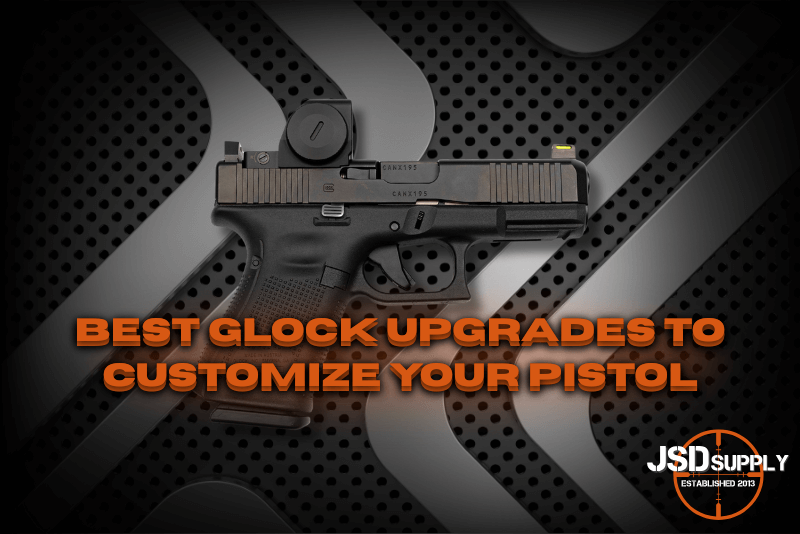
Glock pistols have earned their reputation as some of the most rugged, dependable handguns in the world. They’re carried by law enforcement, trusted by armed professionals, and used by everyday citizens for home defense, concealed carry, and training.
Out of the box, a Glock is a solid, workhorse pistol. But “solid” doesn’t always mean “perfect for you.”
That’s where Glock upgrades come in. With the right aftermarket parts, you can tailor your pistol’s feel, controls, and performance to better match your hands, your shooting style, and your goals on the range.
Let’s walk through some of the most common Glock upgrades and what they actually do for you.
When Gaston Glock set out to design his first handgun, he came from a background in polymers, not firearms. That outsider approach led to a pistol that emphasized simple, consistent operation, lightweight and durable materials, and reliability in harsh conditions.
The result was a handgun that not only found success with government contracts, but also exploded in popularity among civilian shooters. That widespread adoption helped create a huge aftermarket ecosystem, giving today’s Glock owners more upgrade options than almost any other pistol platform.

The factory pistol is built to work for as many people as possible. But hand sizes, mission types, and shooting styles all differ.
Aftermarket Glock parts give you the ability to:
The goal isn’t to “fix” a Glock, it’s to make a good pistol better suited to you.
The trigger is one of the first things people notice when they start shooting seriously.
From the factory, Glock triggers are designed to be safe for carry, consistent from shot to shot, and suitable for duty and defensive roles. Some shooters, especially competitors or frequent range users, want a different feel:
If you decide to change the trigger, focus on quality parts from reputable manufacturers, maintaining safe operation and reliable primer ignition, and performing thorough function checks and test-firing after installation. A good trigger upgrade should help you maintain safety while improving control and consistency.
Glock pistols are deliberately low-profile. That’s great for concealment and minimizing snag points, but for some shooters, especially under stress or with gloved hands, the controls can feel small.
These upgrades can help reduce fumbled reloads, speed up manipulations during training and competition, and improve usability for shooters with smaller hands or limited dexterity. The key is to avoid going so large that controls snag on clothing or gear, especially for concealed carry.
The factory Glock barrel is more than capable for most shooters: it’s durable and accurate enough for defensive distances and typical range work.
That said, barrel upgrades are popular for a reason:
Barrels are generally easy to swap, making them a common “first upgrade” project. Just be sure to choose a barrel designed for your specific Glock model and generation, and test reliability thoroughly with your carry or training ammo before relying on it for serious use.
Your guide rod and recoil spring work together to control how the slide moves during firing. Small changes here can subtly change how the gun feels in your hands.
Changes to spring weight and guide rod mass are best approached as fine-tuning tools, not shortcuts. Any time you adjust the recoil system, make one change at a time, test with the ammunition you actually use, and confirm reliable feeding, extraction, and ejection over multiple range sessions.
A secure, consistent grip is one of the biggest contributors to accurate shooting and fast follow-up shots. While Glock’s factory grip works well for many, it doesn’t fit everyone the same way.
Whatever approach you choose, prioritize a grip that lets you get a consistent, high hand position on the gun, texture that’s secure without being overly abrasive, and compatibility with your holster and carry method if the pistol is used for concealed carry.
The last major category, and one of the most impactful, is your sighting system.
From the factory, many Glocks ship with basic notch-and-post sights. They work, but a lot of owners prefer sights and optics that are easier to pick up quickly.

Popular upgrades include:
Upgrading your sights or adding a red dot is one of the clearest ways to modernize a Glock and tailor it to your eyes and shooting environment.
Customizing a Glock doesn’t mean changing every part. In many cases, a handful of thoughtful upgrades can make a huge difference:
The key is to work with proven, compatible parts, make changes deliberately, and test thoroughly.
JSD Supply is proud to offer the Glock-compatible parts, slides, barrels, guide rods, and optics you need to build a pistol that fits you—not just the average shooter. When you take the time to configure your firearm around your preferences, you’ll see the difference in every range trip and training session.